



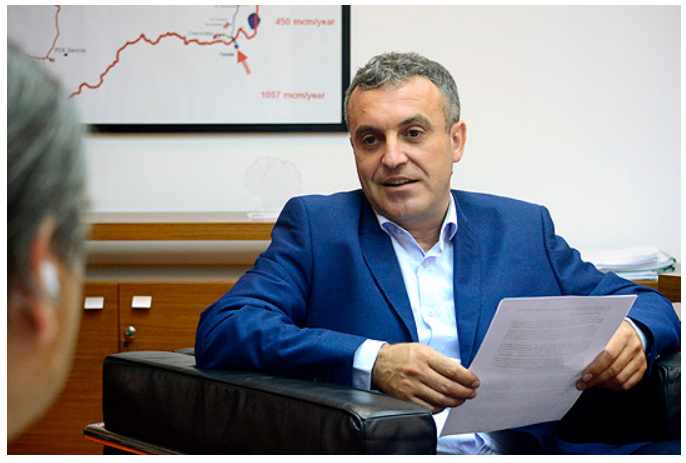
Where will the route of the gas pipeline section from Skopje to Gostivar ultimately go — through Tetovo and through the Vodno Forest Park, as proposed by the Government, or along another broader and much more expensive route, as proposed by the non-governmental organizations? And how is the gas network developing throughout Macedonia in general, as well as the interconnection with neighboring countries? In an interview for MIA, we are discussing about these issues with the director of Macedonian Energy Resources (MER), Bajram Rexhepi.”
Mr. Redzepi you recently assumed your new position and immediately faced reactions from the non-governmental organizations opposing the construction of the main route of the gas pipeline through the Vodno Forest Park. Are you destroying Vodno with this construction as they accuse you of doing?
The word ‘destroying’ Vodno was used very often. I think the word ‘destroying’ is far from appropriate. In reality, Vodno will not only not be harmed by this project, but it will also gain certain benefits. We fully understood the concerns of the non-governmental organizations, the citizens, and the City of Skopje, and we are glad that public awareness is being raised — which is, in fact, good news. Because of this, we had long and very productive communication and cooperation with them, and as a result, the Government decided that the gas pipeline section Skopje – Tetovo – Gostivar, which is planned to extend to Ohrid, will continue to be built along the same route, but with several modifications and measures.
It is planned to reduce the width of the work zone from 25 to 10 meters and to alter the route at the very peak of Vodno, where the high-stem forest is located. The newly proposed route will run alongside an existing trail and an existing road; it is only planned that the road be widened by a few meters on both the left and right sides. In this way, cutting down the forest on Vodno will be further avoided, which, according to the analyses of the public enterprise “Parkovi i Zelenilo Skopje”, amounts to around 1,400 cubic meters of timber. The Government has decided to compensate for the felled forest several times over by reforesting this area and restoring it to its original state within a few months.
It should be clear that apart from the cutting of that quantity of trees, there will be no other negative environmental impacts on Vodno, because the pipeline will be more than one meter underground and, within a few months, the place where the gas pipeline passes will not be recognizable. This is proven and can be seen if you visit already constructed sections, where you can see for yourself on site that nothing is noticeable, except for the markers we place to indicate the route.
Where exactly does the route pass, and what will be the benefits you mentioned?
The route of this section is being built on the southern side of Vodno, which for the most part is not forested. From Sopište it goes toward the peak of Vodno, staying on the southern side the entire time and then descends toward Matka.
The benefits will be multiple. A much larger area will be reforested than what will be cut; it will become a very nice and flat path that will be used for hiking, and the cleared strip that will be created will also serve as a barrier in case of fires.
In addition, bringing gas to these regions will be an absolute replacement for using firewood for heating, and thus millions of cubic meters of wood will be saved in this region and in many others across the country that are currently being cut and used for heating.
Did the non-governmental organizations agree with the proposed changes to the route and the planned measures?
I was positively surprised by the creativity of their ideas and proposals, and several modifications were made precisely based on their suggestions. But among them, the prevailing opinion is that an alternative route should be sought.
What alternative route are the non-governmental organizations proposing?
They believe that a better option would be for the route to be built along the northern ring road of Skopje, or along Skopska Crna Gora. But at this stage, such a radical change is neither rational nor possible. This is based on the extensive analysis we carried out and sent as information to the Government, which—unlike the non-governmental organizations—bears responsibility toward the contracted bodies and financial institutions, especially when the fiscal implications are significant.
Why is a change of the route impossible?
First of all, it’s not that that section is a better option from an environmental perspective. Second, the project already has a legally binding environmental permit, a legally binding construction permit, a completed feasibility study, and all legal-formal procedures have been passed.
The change is not rational because the project will be prolonged at best in 4 to 5 years and it has already been realized at the level of 23% of the entire section. The expropriation procedure is underway, the estimates have been made, proposals have been submitted to the Property and Legal Affairs Office and there are already paid parcels. According to our analysis, the changes will cost the citizens over EUR 20 million.
In addition, the change is not possible because in 2015 the state was indebted in Deutsche Bank and Erste Bank with very strictly defined rules and obligations and the repayment of the loan should begin next year. In 2016, construction and supervision contracts were also signed with strict rules and obligations.
The proposed changes to the route from NGOs will surely bear severe consequences both from financial aspect and from the aspect of the future development plan for gasification. But even if the Government ignores all these legal and contractual obligations and decide on that change and leave the whole Polog region and other regions to be heated on wood and the factories to work on expensive electricity, what is the certainty that after 5-6 years there will be no other non-governmental and civic associations that may have even stronger arguments and will oppose the newly proposed route.
What are your priorities in the coming period?
With the Russian debt, the route from Klečovce to Štip was built, and with the loan from Deutsche Bank and Erste Bank, the line from Štip to Negotino is being constructed. Currently, the sections from Negotino to Bitola and from Skopje to Gostivar, with a branch to Tetovo, are also under construction. At the moment, Macedonia has only one gas interconnection — with Bulgaria near Kriva Palanka — on the gas pipeline operated by GAMA. Work is now underway on an interconnection with Greece along the route of the oil pipeline, and plans exist for connections with Serbia, Kosovo, and Albania.
The interconnection with the Greek operator DESFA is our top priority. This is very important for the country because it diversifies our supply sources — we will have a direct connection to the TAP pipeline, which uses gas from the Shah Deniz field in Azerbaijan. In the past few months, we have had intensive negotiations with DESFA regarding the interconnection with Greece, and a memorandum of cooperation has already been signed. We expect to have a feasibility study by the end of September and to apply for a grant for the basic project. At the same time, we have had intensive negotiations with international financial institutions to close the financial structure, which will be funded partly by grants and partly by a soft loan.
The plan is for the interconnection with Greece to follow the route of the existing oil pipeline, from Negotino through Gevgelija, and to connect in Nea Mesimvria on Greek territory, which is directly connected to TAP. Our section will be approximately 78 kilometers long.
Negotiations for interconnections with Serbia, Kosovo, and Albania are also nearing completion. The interconnection with Kosovo is very important to us because we can use our gas pipelines to transit gas to Kosovo. We need to move quickly on this. With connections to Serbia and Albania as well, the region will become much more competitive, and we will have alternative gas supply sources.
How are things progressing on the sections from Negotino to Bitola and from Skopje to Gostivar with the branch to Tetovo, and is there interest from companies in the zones to connect to the gas pipeline?
On both sections, the implementation progress is between 23 and 25 percent. In addition to construction, funds for expropriation have been secured, and we are working intensively to complete the expropriation process on time; it is extensive, but it is proceeding well. There are a few issues with planning coverage in the municipalities that adopted plans after the route was defined, and we are working intensively to remove these obstacles so that work can continue as planned and the project can be completed on time.
According to our timeline, construction work on the two sections should be completed by the end of 2019 and the beginning of 2020. Technical inspections and testing will follow, and we expect them to become operational in the second half of 2020. This year, about 40 kilometers of these sections are planned to be built.
There is certainly interest from companies to connect, because with the construction of the gas pipeline, gas consumption will increase, which in turn will mean lower gas prices for end consumers. The interconnection with Greece will also contribute to lowering the price, because Macedonia will be supplied with gas from two sides — Russian gas from Gazprom via Bulgaria, and Azerbaijani gas from DESFA via Greece — which will mean greater competition and lower prices.