



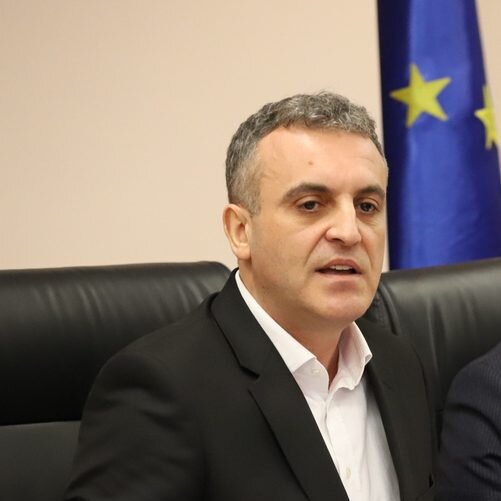
Redzepi for KDP: Energy is crucial in the geopolitics of our century
Bajram Redzepi, Director of the state company ‘National Energy Resources,’ says that energy is the key factor in the geopolitics of this century. However, he emphasizes that, aside from Serbia, other countries in the Western Balkans do not use much natural gas.
‘And even this small amount that is used comes entirely from Russia,’ Redzepi stresses in an interview with KDP.
‘The Western Balkans region is less vulnerable than the rest of Eastern Europe and the EU as a whole.
In recent years, we have witnessed that the powerful countries in the EU have shown an extraordinary lack of solidarity and disharmony with the countries of Eastern Europe. This creates high vulnerability in these countries and incalculable economic and geopolitical damage,’ Redzepi says.
Read the full interview below:
KDP: The world is facing an energy crisis, which threatens to cause negative effects on European economies. What is really happening?
Redzepi: No, I do not agree that the energy crisis is global. The focus of the crisis is in Europe. There are many factors that have influenced this crisis, but some of them are key determinants. The first was the sharp increase in demand for energy resources in many European countries this summer, after the epidemiological situation improved, and the longer-than-usual winter. Second, this summer there were unfavorable conditions for electricity production from renewable sources, especially wind. But the main reason is the urgent reduction of Russian gas flow through Ukraine, because they began filling the pipeline in the new Baltic route. Meanwhile, the European Union has significantly reduced the use of coal and nuclear energy for electricity production. This is where the cause of this energy crisis must be sought.
The negative economic effects are now real, despite the subsidies and interventions carried out by most governments in the EU countries and the region. It is clear that many countries will experience even double-digit inflation, since most industries are directly dependent on electricity and natural gas.
KDP: How many countries in the Western Balkans are dependent on Russian gas? Can this dependence be used as a tool to increase influence? If so, how?
Redzepi: Redzepi: Except for Serbia, in other countries of the Western Balkans there is currently no significant use of natural gas, but even this small amount that is used comes entirely from Russia. However, the commissioning of the Southern Gas Corridor – TAP, and the construction of new LNG terminals in the region, significantly reduce this dependence and diversify supply sources.
Energy in general is a key factor in the geopolitics of the century we live in, but the Western Balkans region is less vulnerable than the rest of Eastern Europe and the EU as a whole. In recent years, we have witnessed that the powerful countries within the EU have shown extraordinary lack of solidarity and disharmony with Eastern European countries, which creates high vulnerability in these countries, causing incalculable economic and especially geopolitical damage.
KDP: At what price do the Balkan countries buy gas individually, specifically North Macedonia? If there are differences, why does one country buy it cheaper while another pays more?
Redzepi: The natural gas market is open and cheap. The problem lies in countries that have no alternative sources of supply, like we do as a state at the moment, which allows prices to vary. This year, the average supply price in Macedonia is less than $300 per 1,000 m³ of natural gas, but that does not mean we will have the same situation next year.
KDP: How much gas is used as an energy resource in North Macedonia (percentage-wise) compared to other resources?
Redzepi: Referring to last year’s data, around 7,400 GWh of electricity and about 3,200 GWh of natural gas are consumed in our country. This is a more understandable comparison without counting other energy resources: oil, wood, coal, thermal energy, solar, etc.
However, the vast majority of our natural gas is used by the TE-TO power plant for electricity production.
KDP: The construction of the gas pipeline in North Macedonia has been announced for some time. When will businesses and households be able to connect to the gas network?
Redzepi: Planning and constructing energy capacities is not something that can be done in a single year. The nature of these projects requires long-term planning. Natural gas is used today, but not on a large scale. Our plan is to achieve widespread use while maintaining economic rationality. We have built around 270 kilometers of the transmission network, with about 10 kilometers remaining to complete the current projects. We are still in the midst of the pandemic crisis, and it is not advisable to make precise forecasts, but I believe that, barring any extraordinary situations, next year all these sections will be operational, and we will select the company that will carry out distribution throughout the cities.
KDP: Where does North Macedonia currently buy gas from and are there any plans to diversify resources in order not to depend on a single supplier?
Redzepi: At the moment, we have only one interconnection line with Bulgaria, with a capacity of 800 million m³ per year. This means we are entirely dependent on Russian gas. We are making every effort for construction of the interconnection line with Greece to begin next year, which will create access to supply from many other sources. Our plan is for this line to be operational by the end of 2023 and to provide many more supply resources.
KDP: How do you assess Russia’s presence in the energy sector in the Western Balkans and North Macedonia?
Redzepi:I believe it is clear to us that energy is the most powerful geopolitical weapon today. On the other hand, a market economy is a fundamental value of democratic systems. Meanwhile, as a country, we have agreed to meet the goals of the EU Green Deal, so that by 2050 we will be free from the use of fossil fuels as an energy source. This requires major investments in new eco-friendly capacities, but it also creates a gap in the energy market, and Russia certainly does not want to be merely a spectator of this transition. In this field of competing interests, long-term strategy and political skill are more than necessary, but often insufficient.
I believe that as a country we are on the right path, but unfortunately, in the meantime, we remain a very small energy actor and directly dependent on the orientations of the major players.
KDP: The government of Kosovo has warned that it will halt the construction of the interconnection gas pipeline with North Macedonia. How do you comment on this warning?
I have closely followed the debate on this topic in Kosovo. We have a signed memorandum between the competent ministries for the construction of the interconnection gas pipeline, and we have not yet received official confirmation of any suspension. Regarding the feasibility study, around €650,000 has been spent so far, a WBIF grant via the European Union, and even more has been spent by MCC in Kosovo.
Kosovo has significant coal reserves, and everything would be fine if electricity production in coal-fired power plants continued normally. However, all international financial institutions have now suspended financing for coal power plants, as have commercial banks, because taxes on this production in the coming years will be very high, making the operation of the plants economically unfeasible. Not to mention the environmental aspect. Research has shown that nearly 19,000 people in EU countries around us have died in the last three years as a result of pollution caused by power plants in the Western Balkans. Imagine what the situation could be for us.
I believe it is necessary to clarify some important facts. First, through this interconnection, Kosovo will be able to be supplied with gas from any supplier in the world, including LNG – American. Second, this infrastructure, besides transporting gas, can also be used for hydrogen transport, so it will be used for much longer than the next 30 years. Third, gas is a much more environmentally friendly energy resource and will be the only way to balance the energy system, which is claimed to be based on renewable sources. I believe that if Kosovo halts this project, over the next 10 years it will continuously increase its energy dependence on imported electricity, which could create economic instability and significantly increase the inflation ratе.